


Global Fashion Collective brought four markedly different design languages to London Fashion Week on 20 September, presenting its Spring/Summer 2027 showcase at Protein Studios Shoreditch as part of the Fashion Scout schedule. Spiky Cherry from Germany, Oscuro from France, ME maria elena di terlizzi from Italy and Joachim from Lesotho moved between sculptural crochet, dark tailoring, graffiti-informed couture and Basotho cultural references, giving the collective runway its strength through contrast rather than a prescribed shared aesthetic.
Spiky Cherry: When Grace Is Constructed
Berlin-based Spiky Cherry opened a particularly personal line of enquiry with Manufactured Grace. Founder Anna Tchashin drew on her past as a competitive ice dancer to examine the tension between the apparent effortlessness of performance and the discipline, repetition and physical strain required to produce it.
Crochet becomes central to that argument. Instead of treating it primarily as a soft or domestic technique, Tchashin uses hand-combined yarns, fragmented surfaces, raw edges and deconstructed construction to wrap, compress, expose and distort the body.
The collection places delicacy beside the visual codes of punk and goth culture, making softness operate almost as armour. That collision gives Manufactured Grace a more specific perspective than a straightforward sports reference: the polished image of the performer is placed against the physical reality required to sustain it.


Oscuro: Darkness Through Tailoring
French label Oscuro, founded by self-taught designer Xavier Lopez, made its London debut with UMBRA.
The SS27 collection remains within the brand’s characteristic deep-black palette but shifts towards a colder and more structured interpretation. Precise tailoring is combined with the utility and attitude of premium streetwear, while silhouette, texture and construction are given greater emphasis than overt decorative narrative.
That restraint is part of the collection’s identity. Rather than explaining every look through a fixed storyline, UMBRA leaves space for the garments to be read through proportion and material. Dark tailoring and urban utility become less about conventional formality and more about establishing a controlled, severe visual language.


Maria Elena Di Terlizzi: Graffiti Becomes Couture Memory
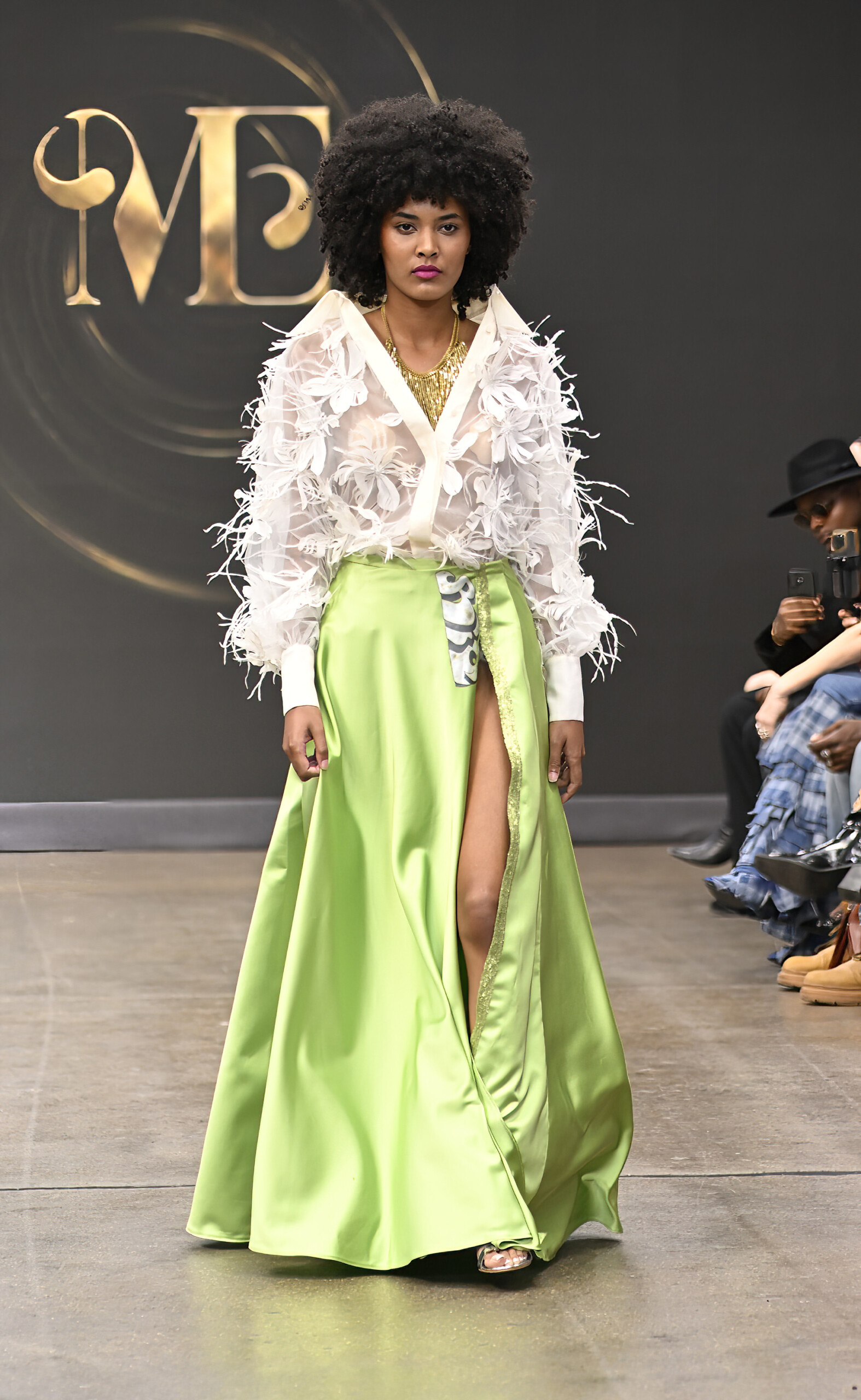
Italian designer ME maria elena di terlizzi presented RYO King of Green, a collection dedicated to Ryo, a close friend and writer whose street art appeared on train carriages travelling from Apulia across Europe.
The personal memory becomes tangible through colour and technique. Magenta, green and metallic silver are combined with sharply defined gradients inspired by Ryo’s murals, while georgette, silk and structured cady introduce contrasting weights and movement.
Pleating references railway tracks, creating a direct connection between garment construction and the trains that carried the original graffiti. Hand embroidery, mesh weaving and bespoke hand-painted fabrics bring elements of Ryo’s work more directly into the clothes.
The result connects two practices that might initially appear distant: the meticulous construction associated with couture and the immediacy of graffiti. Rather than positioning street art as surface decoration alone, Di Terlizzi uses it as the basis for a collection about friendship, place and remembrance, grounded in the tailoring traditions of Apulia.


Joachim: Basotho Culture in a Contemporary Luxury Context
Founded in Lesotho by Katiso Joachim Tsoho, Joachim approached heritage through another route entirely.
The collection draws from Basotho cultural symbols and traditions including Litema decorative practice, the Thebe shield, Mokorotlo, Mohobelo and Basotho blankets. These references are translated through patterns, knit structures, silhouettes, graphics and detailing across knitwear, tailoring, outerwear and accessories.
What matters here is not simply the presence of recognisable cultural references, but the attempt to develop them within a contemporary design system. Joachim’s stated aim is to preserve cultural identity while allowing craftsmanship and design language to evolve, positioning Lesotho as the foundation of the work rather than something that needs to be diluted for an international audience.
This approach gives the collection a clear proposition: tradition can move into new forms without becoming detached from its cultural origin.


Four Designers, Four Routes Into Identity
The Global Fashion Collective presentation was most convincing when viewed through the differences between its participants.
Spiky Cherry turns personal experience and competitive performance into manipulated crochet. Oscuro reduces colour in order to sharpen the relationship between tailoring and streetwear. Maria Elena Di Terlizzi transforms the memory of a friend and his graffiti into couture technique, while Joachim brings Basotho visual and material references into contemporary luxury.
Together, the four collections show how international fashion showcases can function without reducing designers to one broad idea of “global” creativity. Each practice arrives with a different geography, technique and relationship to identity.
For Global Fashion Collective, whose runway programme operates across several international fashion capitals, the London SS27 presentation therefore worked as a meeting point rather than a uniform statement: four designers using the runway to establish highly individual arguments about craft, memory, culture and the body.

FASHION FRONTIER
Fashion Frontier is a London-based digital fashion magazine exploring the edge of modern style, creativity, and culture. The platform features designer lookbooks, runway reports, event coverage, and stories redefining the future of fashion in the UK and beyond.
You may also like

Fashion For Freedom Brings Ukraine’s Voices to Milan Fashion Week 2025
On 26–27 September 2025, the Sheraton Milan San Siro will host Fashion For Freedom | Milan Fashion

Pearl Academy Showcased Distinctive Indian Fashion Voices at London Fashion Week SS26
During London Fashion Week SS26, Pearl Academy brought forward a vibrant showcase of distinctive and

London Fashion Day Announces Registration for Its 5th Season
London Fashion Day is thrilled to announce the official opening of registration for its 5th season,




Post a comment