


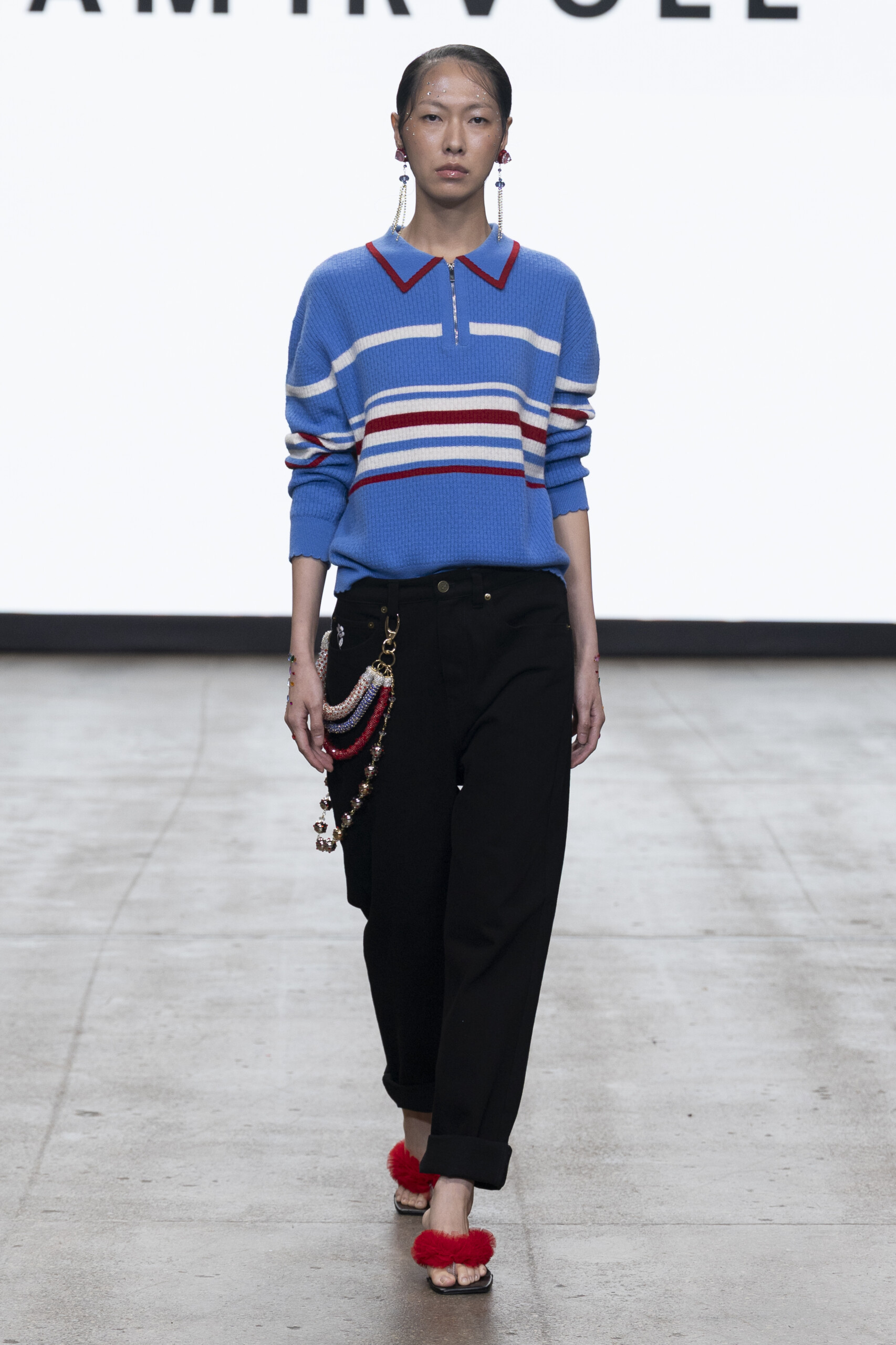
Norwegian designer Fam Irvoll returned to London Fashion Week with Original Partymonster, an SS27 collection that reconnects her maximalist design language with the London club culture that helped shape it. Presented with Fashion Scout, the collection looks back to the early-2000s world surrounding East London night BoomBox, translating its emphasis on self-invention into sporty silhouettes, bold prints, dimensional details and an expanded range of accessories.
From London Nightlife to the Runway
Irvoll has long occupied a different territory from the restrained minimalism often associated with Scandinavian fashion. Colour, humour, exaggerated proportion and handmade surface work have instead become recurring elements of her practice, allowing clothing to operate somewhere between dress, character and visual performance.
For Original Partymonster, those qualities are connected directly to her time in London.
Irvoll studied at ESMOD Oslo and Central Saint Martins during a period when London nightlife offered its own informal education in fashion. Within the club environment, clothing could communicate identity immediately: a silhouette, colour combination or deliberately excessive look became part of how a person constructed and presented themselves.
BoomBox provides one of the collection’s most specific references. The East London club night became associated with the meeting of fashion, music and highly individual styling, creating a context in which experimentation was not separated from nightlife.
SS27 does not attempt to recreate that scene as costume. Instead, Irvoll draws on its freedom and visual confidence, bringing the attitude of the period into a contemporary collection.
Maximalism With Craft Behind It
The collection combines sportier shapes with the exaggerated language already associated with Fam Irvoll. Bold prints sit alongside sculptural three-dimensional elements, while dresses, mesh and recycled denim broaden the material and silhouette vocabulary.
The visual excess is supported by detailed making. Embroidered surfaces, tactile embellishment and handmade statement pieces give physical depth to prints and colour, preventing maximalism from operating only at the level of graphic impact.
That distinction is important to Irvoll’s work. Humour and fantasy may be immediate, but their effectiveness depends on construction. Dimensional elements change the silhouette as the wearer moves, while embroidery and embellishment bring a slower, materially intensive process into clothes designed to look spontaneous.
SS27 also expands the wider Fam Irvoll universe through jewellery, earrings and accessories. These additions make sense within a collection concerned with club culture, where identity is rarely communicated through clothing alone. Accessories become another layer of personal styling rather than an afterthought to the main garments.




Looking Back Without Recreating the Past
There is an obvious nostalgic component to revisiting the club culture of the early 2000s, particularly two decades into Irvoll’s career. Original Partymonster, however, is most interesting when viewed less as an exercise in revival than as an examination of how a designer’s visual language develops.
The collection returns to an environment in which experimentation, performance and personal style were interconnected, but those influences now sit alongside the techniques and forms Irvoll has developed since.
That makes the London reference biographical as much as aesthetic. The clothes are informed by something experienced rather than simply researched: a particular moment when nightlife, fashion education and emerging creative identity overlapped.
At a time when fashion imagery can circulate internationally within seconds and visual references are increasingly shared across the same digital platforms, Original Partymonster makes a case for the value of specificity. Irvoll’s maximalism comes from a recognisable set of experiences, interests and methods rather than from an attempt to align with a single seasonal aesthetic.
Twenty years into her practice, returning to the idea of the “partymonster” therefore becomes less about repeating an earlier version of herself and more about identifying what has remained constant: colour, craft, humour, transformation and the freedom to take up visual space.
Explore Fam Irvoll and follow @famirvoll on Instagram

FASHION FRONTIER
Fashion Frontier is a London-based digital fashion magazine exploring the edge of modern style, creativity, and culture. The platform features designer lookbooks, runway reports, event coverage, and stories redefining the future of fashion in the UK and beyond.
You may also like

2023 Creative Industry Awards
Held in Birmingham, last week Saturday witnessed the vibrant and exciting Creative Industry Awards,

Odessa Fashion Day: Celebrating Ukrainian Design and Innovation in its 28th Season
Odessa, Ukraine – April 26 – Odessa Fashion Day, one of the leading fashion events, prou

Raindance Film Festival starts October 25th in London
For the 31st edition of the Raindance Film Festival, the UK’s leading indie film festival, is ret



Post a comment