


Global Fashion Collective SS27 Day Two Moves From Youth Nostalgia to Indigenous Storytelling at NYFW
Global Fashion Collective continued its Spring/Summer 2027 New York Fashion Week programme at The GlassHouse on 12 September with six labels whose collections moved between youth nostalgia, ethereal femininity, socially conscious tailoring, architectural form and Indigenous cultural storytelling. The second day offered no single definition of contemporary international fashion; instead, it showed how designers from Canada, Thailand, South Korea and the United States are using personal memory, cultural inheritance and craft to build markedly different runway languages.
ALEX S. YU: Love as Transformation
Canadian label ALEX S. YU presented error143 : null, a collection inspired by the 2004 Taiwanese drama Dou Yu and centred on youth, emotional change and the destabilising force of love.
The collection begins softly, with tulle, chiffon, pale greys and pastel tones suggesting innocence before moving towards distressed leather, raw denim, earthier colours and hardware. The materials become progressively more assertive as the silhouettes expand and fragment, culminating in larger forms rendered in deep blues and black.
That progression gives the collection a clear visual structure. Rather than illustrating romance literally, ALEX S. YU uses texture and proportion to suggest the way an intense relationship can alter a person’s sense of self.


Fairy Princess Bangkok: Softness Without Fragility
Fairy Princess Bangkok approached SS27 from an almost opposite direction with Ethereal DNA.
Soft colour, transparent fabrics and detailed construction build a deliberately delicate surface, but the collection positions that delicacy as a form of confidence rather than weakness. Complex structures sit beneath airy materials, creating a tension between visual lightness and the labour required to make each garment.
The brand states that pieces are produced in limited quantities by skilled artisans, connecting its language of individuality to the way the clothes are made as well as to their appearance.
The collection’s idea of an inner “princess” is therefore less about conventional fairytale dressing than about self-possession: allowing softness, individuality and ornament to exist without being treated as passive.


BLUETAMBURIN: Elegance With a Social Argument
South Korean label BLUETAMBURIN returned to New York with Justice in Elegance, led by creative director Bomin Kim.
The collection reworks classic couture silhouettes through a narrative of integrity, dignity and leadership. Refined tailoring and traditional ideas of elegance provide the visual framework, while the opening looks draw on the dreams and aspirations of young girls.
This social emphasis is central to the brand’s own philosophy, which positions clothing as capable of carrying ideas beyond appearance. In Justice in Elegance, the collection frames elegance not simply as polish or formality, but as something connected to responsibility and confidence.
That proposition is most convincing where the message remains tied to construction: controlled silhouettes, tailored lines and restrained forms give the wider concept a visible structure rather than leaving it purely rhetorical.


Somaya Fashion Studio: Architecture as a Metaphor for Change
Afghan-Canadian designer Somaya Ahmadi presented Threshold through Somaya Fashion Studio, using architecture to explore the uncertain space between one identity and the next.
Archways, curtains and woven structures become references for passage and transition. Sculptural forms are offset by more fluid movement, while earthy neutrals, deep blue, ivory and chartreuse reflect changes in light across architectural spaces.
The collection is designed as a progression. Each look represents another stage between uncertainty and confidence, giving the runway a narrative of transformation without relying on literal before-and-after imagery.
Here, architecture works less as a decorative source than as a way of thinking about transition: thresholds, openings and structural boundaries become visual equivalents for personal change.


Foxfire Designs: Indigenous Identity on the Contemporary Runway
Foxfire Designs, founded by Indigenous designer Cathy Lopez, presented work rooted in the heritage and artistic traditions of the Hopi and Santa Ana Pueblo communities.
According to the collection notes, traditional sewing techniques and cultural storytelling passed through generations inform the garments, alongside references to the landscapes and visual language of the American Southwest.
The strongest aspect of the collection is its insistence that cultural continuity does not require visual stasis. Lopez uses contemporary silhouettes while maintaining a clear connection to the traditions and communities that inform the work.
That distinction matters when heritage enters an international runway context. Rather than treating Indigenous reference as a generic aesthetic, Foxfire Designs locates the collection within specific cultural foundations and presents contemporary fashion as one way those foundations can continue to evolve.


Arabesque Boudoir: Authority Through Historical Reference
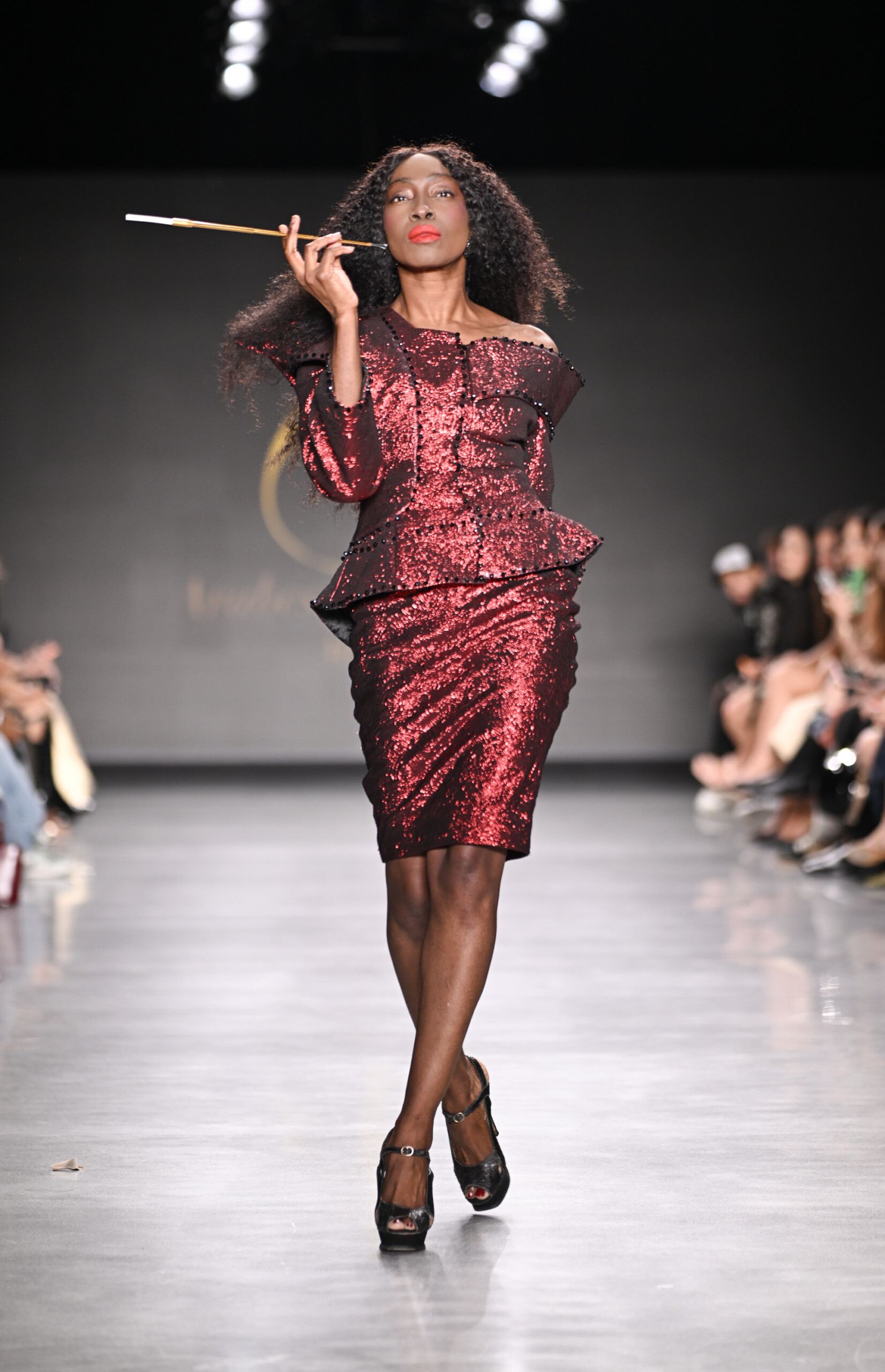
Arabesque Boudoir, led by designer Maya Mosteghanemi, presented Anna Style, named in homage to fashion editor Anna Wintour.
The collection combines 1960s French womenswear with references to Renaissance France and the Golden Age of the Ottoman Empire. Sharp shoulders and assertive silhouettes are softened by controlled glimpses of skin, embroidery and elaborate appliqué.
Its understated palette allows construction to carry much of the impact. Rather than relying on colour for drama, the collection builds authority through shape, surface and proportion.
The stated subject is a woman dressing for herself rather than for approval, and the strongest looks support that idea through silhouette: shoulders, tailoring and controlled volume create presence before embellishment is added.




Six Different Routes Into Identity
The six presentations make the second day of Global Fashion Collective difficult to reduce to one seasonal trend, and that is precisely what gives it value.
ALEX S. YU treats emotional upheaval as a material transformation. Fairy Princess Bangkok argues for softness as strength. BLUETAMBURIN connects couture language with ideas of social responsibility, while Somaya Fashion Studio uses architecture to visualise personal transition. Foxfire Designs centres Indigenous cultural continuity, and Arabesque Boudoir turns historical references into a contemporary study of feminine authority.
Across these collections, identity is not treated as a fixed theme that can be applied uniformly. It appears through memory, culture, aspiration, architecture, craft and the body.
For Global Fashion Collective, the New York platform again functions less as a single aesthetic statement than as a shared runway for designers whose work begins from very different places.

FASHION FRONTIER
Fashion Frontier is a London-based digital fashion magazine exploring the edge of modern style, creativity, and culture. The platform features designer lookbooks, runway reports, event coverage, and stories redefining the future of fashion in the UK and beyond.
You may also like

ANCIELA SS27 Explores Motherhood and Material Innovation at London Fashion Week
London-based womenswear label ANCIELA presented its SS27 collection at Regent Quarter on 17 Septembe

London Fashion Day Announces Registration for Its 5th Season
London Fashion Day is thrilled to announce the official opening of registration for its 5th season,

London Fashion Day’s Fourth Season: A Global Stage for Rising Designers and Sustainable Style
On November 2, 2024, the historic St John’s Church in Hyde Park was transformed into a lively


Post a comment