


Global Fashion Collective SS27 Brings International Craft and Identity to New York Fashion Week
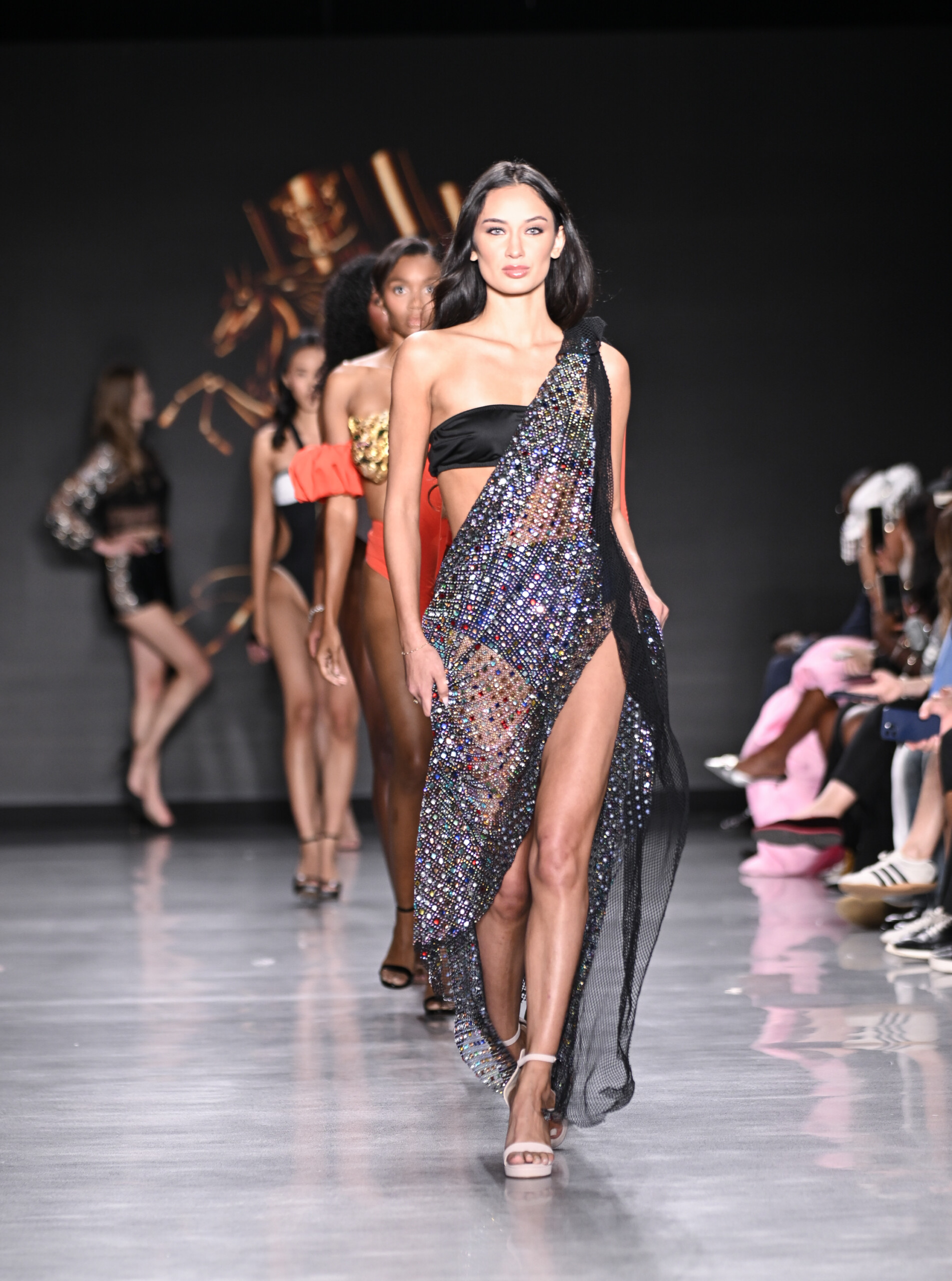
Global Fashion Collective returned to New York Fashion Week for Spring/Summer 2027 with runway presentations at The GlassHouse, bringing international perspectives on couture, resortwear, cultural memory and craft into the Manhattan setting. The 11 September programme included designers from Peru, the United States, Canada, Taiwan and South Korea, with collections ranging from sculptural eveningwear and Caribbean luxury to Taiwanese market memories and fashion conceived around social purpose.
Noe Bernacelli: Romance Built Through Structure
Peruvian designer Noe Bernacelli approached SS27 through a controlled form of romanticism, balancing blush and nude tones with increasingly dramatic surface and colour.
Corsetry provides much of the collection’s architecture, while lace, feathers, shimmering embellishment and fluid draping soften the construction around it. Sheer foundations expose aspects of how each silhouette is built rather than concealing the structure completely.
The palette eventually moves into deep crimson, giving the runway a more forceful conclusion after the lighter opening tones. What keeps the collection from becoming purely decorative is its emphasis on proportion: embroidery and dimensional elements are used alongside precise construction, placing texture in direct conversation with the body.


Follow @noebernacelli.
Maison Hadascha: Caribbean Luxury Across Resort and Knitwear
Haitian-American designer Hadascha Volny brought Maison Hadascha to the New York runway with a collection grounded in Caribbean heritage and conceived across resort ready-to-wear, swim, lounge and knit couture.
Rather than separating these categories into different visual worlds, the collection links them through fluid movement, confident silhouettes and a more refined approach to warm-weather dressing.
Structure appears without overwhelming ease, allowing the clothes to move between the language of resortwear and more considered occasion dressing. The result positions Caribbean reference as part of a contemporary luxury proposition rather than as a purely decorative theme.



Follow Maison Hadascha on Instagram.
Richard Wei: Eveningwear as a Form of Art
Vancouver-based Canadian designer Richard Wei presented Fashion is Art, using sculptural gowns, luminous fabrics and fluid draping to explore eveningwear as both clothing and visual composition.
The collection draws on the tension between structure and movement. Precise tailoring and embellishment create control, while long draped lines allow the fabric to respond more freely to the body.
Wei’s Vancouver context — where urban life exists alongside mountains and ocean — informs the collection’s stated balance between formality and openness. Rather than treating the gown as a static object, Fashion is Art frames each silhouette as something activated through movement.


Follow @richardwei.ca.
Erika Chung: Everyday Taiwan Reworked Through Couture
Taiwanese designer Pei-Yin Chung brought ERIKACHUNG to New York with Taiwan Cha Mou Zai, a collection rooted in childhood memories of local market life.
Chung recalls watching her mother place fresh vegetables into traditional woven bags, turning those familiar textures and weaving techniques into a contemporary fashion language.
Hand-weaving and lace soften precisely engineered silhouettes, while traditional Chinese characters, Eastern knotting and references to Taiwanese everyday culture — including bubble tea — give the collection a specific sense of place.
According to the collection notes, Chung also used Tencel and Greencell fibres in lace and organza. These lighter materials sit alongside the more personal cultural references, connecting technical experimentation with an autobiographical starting point.


Carlton Jones: Camouflage Beyond the Military
New York designer Carlton Jones presented Second Nature, continuing his exploration of the relationship between city dressing and resortwear.
The collection began with an observation made along the shores of Puerto Rico and reconsidered camouflage through nature rather than military uniform. Pattern, texture and concealment become organic references rather than symbols of combat.
Lightweight mesh and Tencel support the collection’s relaxed silhouettes, maintaining the ease associated with Jones’s resort sensibility while allowing the clothes to move between urban and coastal contexts.
His Caribbean heritage, New York roots and long career as a stylist converge in a wardrobe that treats resort not simply as destination dressing, but as an approach to how clothes feel and move.


Claire Marie: Renaissance Dress Reconstructed by Hand
Designer Claire Marie Francom looked further into the past with A Modern Renaissance, a collection inspired by Italian and English Renaissance dress.
Each of the eight gowns incorporates a lace-up corset, providing a consistent structural foundation beneath velvet, brocade, satin, lace and silk. Red, purple, gold, green, black and white reinforce the historic reference, while contemporary styling prevents the clothes from reading as direct reproductions of period costume.
Craft is especially central to Francom’s practice. Having learned to sew with her mother as a child, she continues to make her designs herself, giving the collection’s historical reference a direct connection to hand construction.
Explore Claire Marie.


BLTAM ENTRE: Young Designers Address Social Goals
South Korean collective BLTAM ENTRE brought one of the programme’s most unusual perspectives through designers Jane Shin, Eunwoo Ji, Jia Kim and Jiyoon Lee, aged between 10 and 12.
Founded by Korean designer Bomin Kim, the project gives young designers a framework through which to connect fashion with wider cultural and social questions.
For SS27, each participant interpreted a United Nations Sustainable Development Goal, addressing themes including education, economic equality, health and healing, peace and justice.
Korean natural silk, medical references, Eastern and Western visual elements and more refined silhouettes were used as vehicles for those subjects. The result places the runway less as an endpoint for finished clothes and more as a space in which younger creatives can test how design communicates an idea.


Seven Different Ways to Read SS27
What connects these collections is not a single seasonal silhouette. Their approaches are too different for that.
Bernacelli builds romance through corsetry and embellishment. Maison Hadascha works through Caribbean-informed luxury and resort dressing. Richard Wei treats eveningwear as artistic composition, while Erika Chung turns the material memory of Taiwanese market life into couture technique. Carlton Jones reinterprets camouflage through nature, Claire Marie reworks Renaissance construction, and BLTAM ENTRE uses fashion to discuss social goals.
That variety is central to the Global Fashion Collective model. Its New York presentation places designers from different cultural and professional contexts on the same runway without requiring them to conform to one aesthetic idea of international fashion.
For SS27, the result was less a statement about one dominant direction than a demonstration of how differently craft, identity and personal history can enter contemporary design.

FASHION FRONTIER
Fashion Frontier is a London-based digital fashion magazine exploring the edge of modern style, creativity, and culture. The platform features designer lookbooks, runway reports, event coverage, and stories redefining the future of fashion in the UK and beyond.
You may also like

Fashion Scout’s Ones To Watch 01 Spotlighted Global Rising Talents at London Fashion Week SS26
On Saturday 20th September 2025, Fashion Scout’s Ones To Watch 01 returned to London Fashion Week

INF AW25 Catwalk Show: Raven-Inspired Fashion at London Fashion Week 2025
INF is set to make a striking impact at London Fashion Week on February 21, 2025, with its AW25 Catw

FJU Talents Brought Taiwan’s Rising Fashion Alumni to Fashion Scout During London Fashion Week
During London Fashion Week SS26, FJU Talents once again spotlighted the creativity and innovation of




Post a comment