


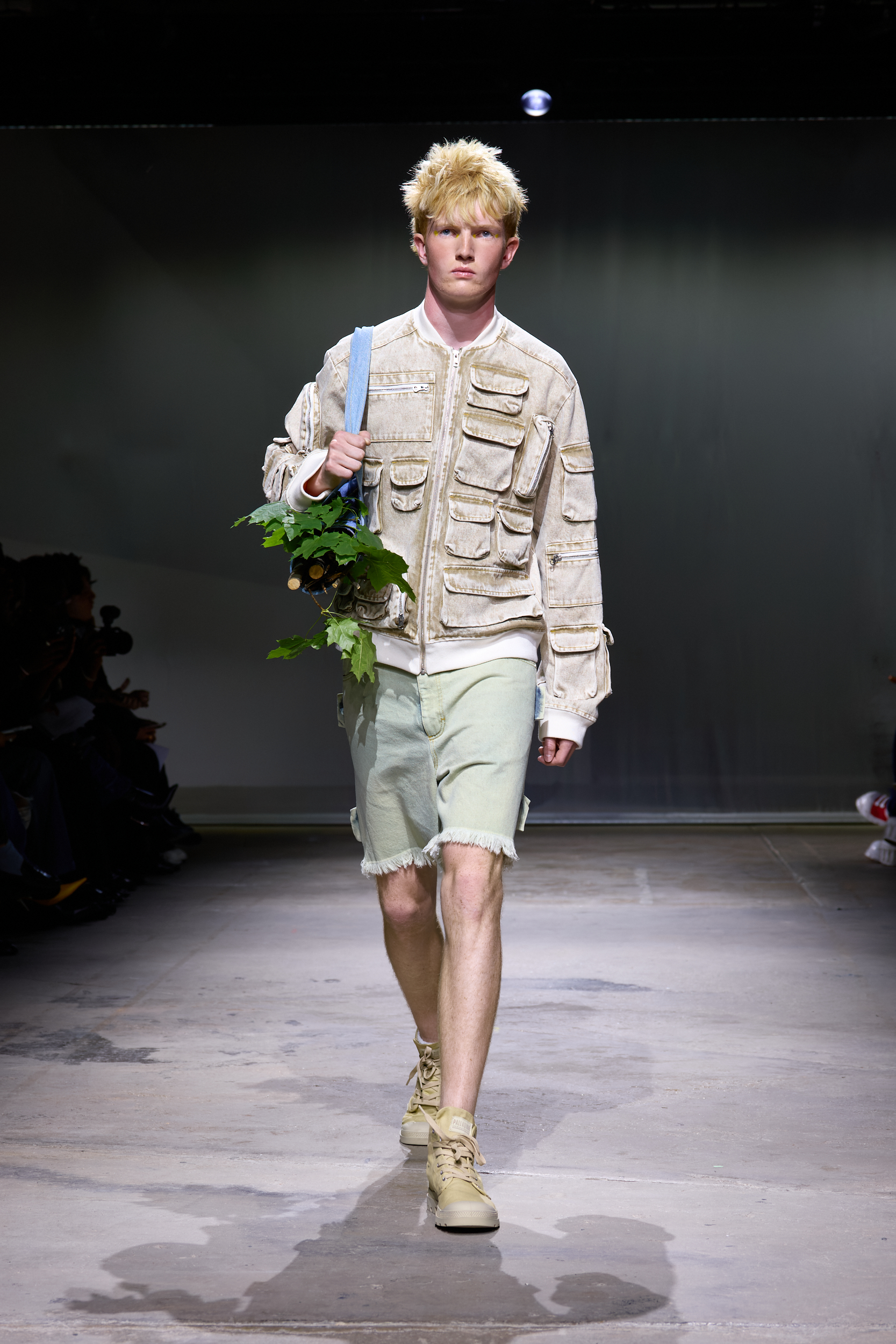
Ukrainian fashion label KSENIASCHNAIDER has presented its Spring/Summer 2027 collection, UTC+1, marking the first season in which co-founder Anton Schnaider takes the lead as Creative Director. Presented during London Fashion Week, the collection reinterprets football shirts, racing uniforms and club merchandise through fictional logos, altered surnames and experimental sportswear. Alongside this graphic exploration of identity, the Kyiv-based label introduces a concept it calls walkwear and continues its collaboration with Lee Cooper through six looks that bring floral prints and softer materials into utilitarian clothing.
The creative shift marks a new chapter for the brand founded by Ksenia and Anton Schnaider in Kyiv in 2011. While the pair have developed the label together for more than a decade, SS27 places Anton’s graphic design background, personal references and fascination with visual symbols at the centre of the collection.
Who Do We Belong To? Fashion as a Language of Identity
Football shirts, racing uniforms and club merchandise communicate identity long before anyone considers their construction. A crest signals allegiance, a number identifies a player, and a sponsor’s logo connects clothing to a wider organisation.
For UTC+1, Anton Schnaider takes these familiar elements and deliberately unsettles their meaning.
Invented club emblems, fictional surnames, numbers and ambiguous graphic marks appear throughout the collection. They resemble the visual language of established teams, companies and communities but do not necessarily refer to anything real.
The word Erm, ordinarily associated with hesitation, becomes a logo. The KSENIASCHNAIDER name is fragmented into graphic puzzles, while faded surfaces retain traces of emblems that appear to have been removed.
Even the surnames challenge expectations. Daughterson resembles an ordinary name but resists a specific national association, while Frijondz draws on historical Germanic linguistic roots associated with friendship and kinship.
The collection’s title follows the same principle. Rather than identifying a country or city, UTC+1 uses a time zone as a form of temporary geographical identity.
“I like the idea of belonging, but I don’t necessarily want to have to belong to something all of the time,” said Anton Schnaider, Creative Director of KSENIASCHNAIDER.
The concept raises a question about the way clothing communicates identity: can someone adopt the appearance of belonging without accepting the expectations that usually accompany it?




From Sportswear to Walkwear
Beyond its graphic language, UTC+1 introduces a practical idea that KSENIASCHNAIDER describes as walkwear.
Where traditional workwear responds to labour and sportswear prioritises athletic performance, walkwear is conceived for everyday movement through cities and changing environments.
The collection imagines the wardrobe of a traveller, urban wanderer or someone moving continuously between different places.
Multi-pocket garments reduce the need to carry a separate bag, while sunscreen bodysuits bring elements of protective performance clothing into everyday dress.
Other details play with the relationship between appearance and purpose. Pseudo-belts retain the recognisable form of an accessory without necessarily performing its conventional function.
This tension between utility and visual symbolism gives the collection an additional layer. Clothing can appear functional while questioning what function actually means, just as its logos suggest affiliations that do not exist.
The result sits between streetwear, travel clothing and experimental design, with familiar references reassembled into garments intended for contemporary urban life.
KSENIASCHNAIDER x Lee Cooper: Florals Meet Utility
The collection also introduces six looks developed through the ongoing collaboration between KSENIASCHNAIDER and Lee Cooper.
Previous chapters of the partnership explored the functionality of denim. For SS27, the designers introduce a softer interpretation of utilitarian clothing.
Romantic floral prints meet cargo pockets, while checks and colourful patchwork interrupt conventional functional silhouettes. Materials associated with summer dressing and domestic textiles are applied to garments traditionally defined by practicality.
Each look is accompanied by a specially designed flower bag, extending the floral reference beyond print and into the silhouette itself.
Rather than abandoning the functional foundations of workwear, the collaboration places them alongside decorative elements more commonly associated with romantic dressing.
The contrast reinforces the collection’s wider interest in objects whose appearance and purpose do not always align.
Made in Kyiv: Production as Part of the Design Language
Although UTC+1 explores fictional affiliations and shifting geographical identities, its production has a clearly defined location.
Every piece in the SS27 collection was made in Kyiv, Ukraine, at KSENIASCHNAIDER’s own production facility.
The atelier has been central to the brand’s development, supporting its established experimentation with denim construction, upcycling, zero-waste techniques and the reuse of existing materials.
For KSENIASCHNAIDER, production is closely connected to creative development. The possibilities and limitations of textiles, construction processes and existing garments have consistently informed the label’s approach to fashion.
That relationship between design and making gives UTC+1 a particularly interesting contrast. The collection questions fixed identities through invented symbols, but its physical production remains firmly rooted in the Ukrainian capital.
A Different Creative Perspective for KSENIASCHNAIDER
Anton Schnaider’s first season leading the creative direction does not abandon the experimental approach associated with KSENIASCHNAIDER. Instead, it introduces another perspective through graphic design, sporting culture and questions surrounding collective identity.
The visual references are familiar, but their meanings remain deliberately uncertain. Logos suggest organisations that do not exist, surnames become messages, and practical clothing details move between function and decoration.
The Lee Cooper collaboration extends that approach by introducing romantic materials into utilitarian construction, while walkwear offers a practical framework for a wardrobe concerned with continuous movement.
With UTC+1, KSENIASCHNAIDER explores how clothing can communicate identity without requiring it to remain fixed.
The result is a collection in which the language of belonging is everywhere, but the need to belong is left open to interpretation.
Show Credits
Creative direction was led by Anton Schnaider, with design by Ksenia Schnaider and Anton Schnaider. Hair was led by Richard Phillipart, with make-up by Rossino Elia-Griffin in collaboration with CMC Agency using Anua Global. Photography was by Leonardo Korfu, Jimin Kwon, Yana Kasa and Maria Salinonova.
The collection was developed in collaboration with Lee Cooper, with Palladium as Official Footwear Partner, Soorty as Official Denim Partner and Blonstein as Official Show Production Partner. Additional partners included 4trans, Spraga and People Pleaser Salad.
Explore the KSENIASCHNAIDER SS27 collection and follow @kseniaschnaider.

FASHION FRONTIER
Fashion Frontier is a London-based digital fashion magazine exploring the edge of modern style, creativity, and culture. The platform features designer lookbooks, runway reports, event coverage, and stories redefining the future of fashion in the UK and beyond.
You may also like

Fashion Scout Ones To Watch Edition 01 Introduces Eight Designers at London Fashion Week
Fashion Scout presented the first edition of its September 2026 Ones To Watch programme at London Fa

London Fashion Day Unveils its Third Season: Elevating Emerging Designers and Brands
London, April 20th – London Fashion Day, a beacon for emerging designers and brands, proudly annou

Raindance Film Festival starts October 25th in London
For the 31st edition of the Raindance Film Festival, the UK’s leading indie film festival, is ret



Post a comment