Fashion Week and the City (FWTC) brought eight distinct design perspectives to St John’s Church, Hyde Park Crescent on 17 September with its London Designer Spotlight, connecting contemporary fashion with textile heritage, handcraft and individual approaches to identity. Across silk essentials, mirror work, Banarasi textiles, batik, eco-leather and distressed organza, the showcase demonstrated how traditional techniques and personal references can be reworked without requiring every designer to arrive at the same aesthetic conclusion.
Eight Approaches to Contemporary Dress
Priyankaa Bajaj introduced Be Me, a lifestyle concept centred on clothing and everyday pieces intended to move between work, travel, rest and other parts of daily life. Rather than defining a narrowly prescribed wearer, the project places comfort, confidence and individual expression at the centre of its proposition.
Eighth Hour, founded by Vasanthi Kris, approached versatility through a more tightly defined material language. Its Essentials collection consists of 33 permanent silk styles spanning dresses, blouses, skirts, jackets, coats, trousers and shirts. Subtle manipulation of the fabric provides detail while the permanent-collection format shifts attention away from constant seasonal replacement.
The contrast between the two illustrates the breadth of the FWTC showcase. One begins with a lifestyle proposition; the other builds a wardrobe around a single material and the idea of permanence.
Inherited Craft in New Silhouettes
Heritage becomes more explicit in Mahimant by Manshi Shankarbhai Bhanushali. The collection VIRASAT uses hand-tie techniques and intricate mirror work to examine how inherited craft can move into contemporary clothing.
Rather than treating craft purely as ornament, the project positions technique as a connection between generations. The significance lies not only in what a textile looks like, but in the knowledge required to create it and the possibility of carrying that knowledge into a different design context.
Ispahan by MB, founded by Maryam Babar, takes another route into textile history. The Pakistani contemporary luxury label presented a couture look pairing a hand-embellished rose-gold lamé silk bomber with Banarasi silk.
The combination deliberately brings different fashion languages together. A bomber, associated with contemporary casual and street-influenced dressing, becomes the setting for elaborate hand embellishment, while Banarasi silk introduces an established textile tradition into a modern silhouette.
Embroidery, Equestrian Codes and Batik
Founded by Dr Sabah, Maison Stylistica presented its Tree of Life ensemble as a hand-embroidered journey through water, land and sky. The look was completed by a sculptural handbag by Ali Fateh, extending the narrative from clothing into accessory design.
Nature operates here as an organising structure, but the hand embroidery gives that theme a material dimension. The ensemble uses craft to connect several symbolic environments rather than relying on print alone to communicate its subject.
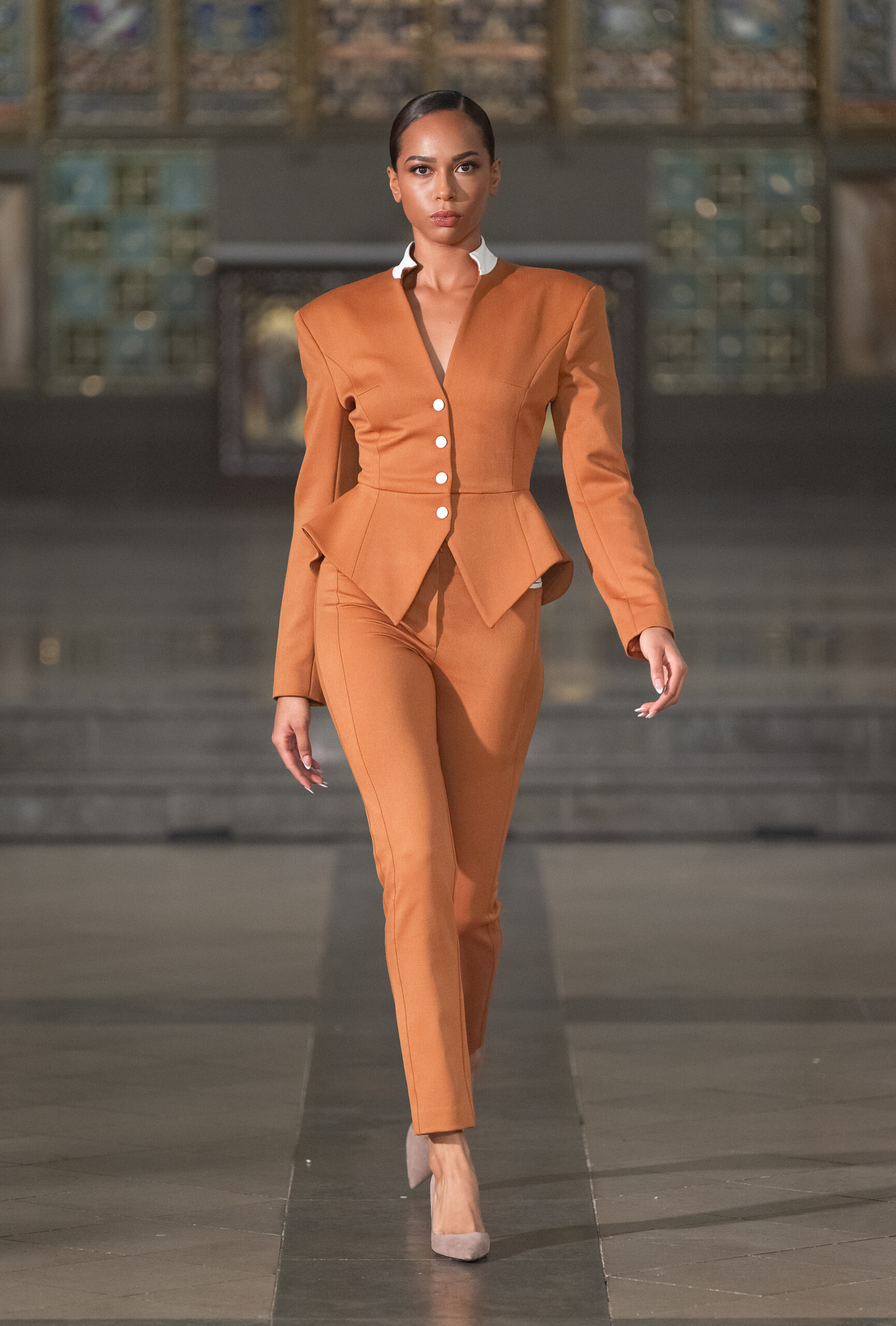
NRoyce, founded by Spiryae Nadezhda, looks instead to equestrian and jockey heritage. Refined suiting, eco-leather and hand embroidery translate those references into contemporary tailoring, retaining recognisable codes of equestrian dress while shifting them into another context.
With Label WDIF, traditional textile practice meets an especially contemporary combination of garments. Founder Manya Manuja’s debut look is centred on batik, the resist-dye technique appearing alongside a corset, denim blazer and tailored shorts.
The result reflects one of the stronger threads running through the Designer Spotlight: heritage is not positioned as requiring a historically faithful silhouette. A technique can remain identifiable even as the clothes surrounding it change.
DLOSTGEN Distorts the Familiar
DLOSTGEN, founded by Aisha Patel, moves the showcase into a more psychologically ambiguous space with A Dream Within a Dream.
Burnt organza, distressed surfaces, layers and distorted proportions are used to explore the boundary between reality and imagination. Where several of the other designers build around established craft practices, DLOSTGEN makes material alteration itself part of the narrative. Fabric appears transformed, disrupted or unstable, creating a physical counterpart to the collection’s interest in uncertain perception.
A Showcase Defined by Difference
Taken together, the eight presentations resist the idea that an international designer showcase needs one visual identity. Silk sits alongside denim; hand embroidery appears beside deliberately distressed fabric; inherited textile processes coexist with lifestyle-led wardrobe design.
The more useful connection is methodological. Each designer begins with something specific — a craft, a material, an equestrian reference, daily movement, landscape or an imagined psychological space — and uses fashion to reinterpret it.
Fashion Week and the City describes its wider platform as connecting designers and creative practitioners through showcases in London, New York and Paris. In the London Designer Spotlight, that international ambition was expressed on a smaller and more detailed scale: eight individual practices, each given room to define what contemporary design means on its own terms.
Fashion Frontier is a London-based digital fashion magazine exploring the edge of modern style, creativity, and culture. The platform features designer lookbooks, runway reports, event coverage, and stories redefining the future of fashion in the UK and beyond.






Post a comment