


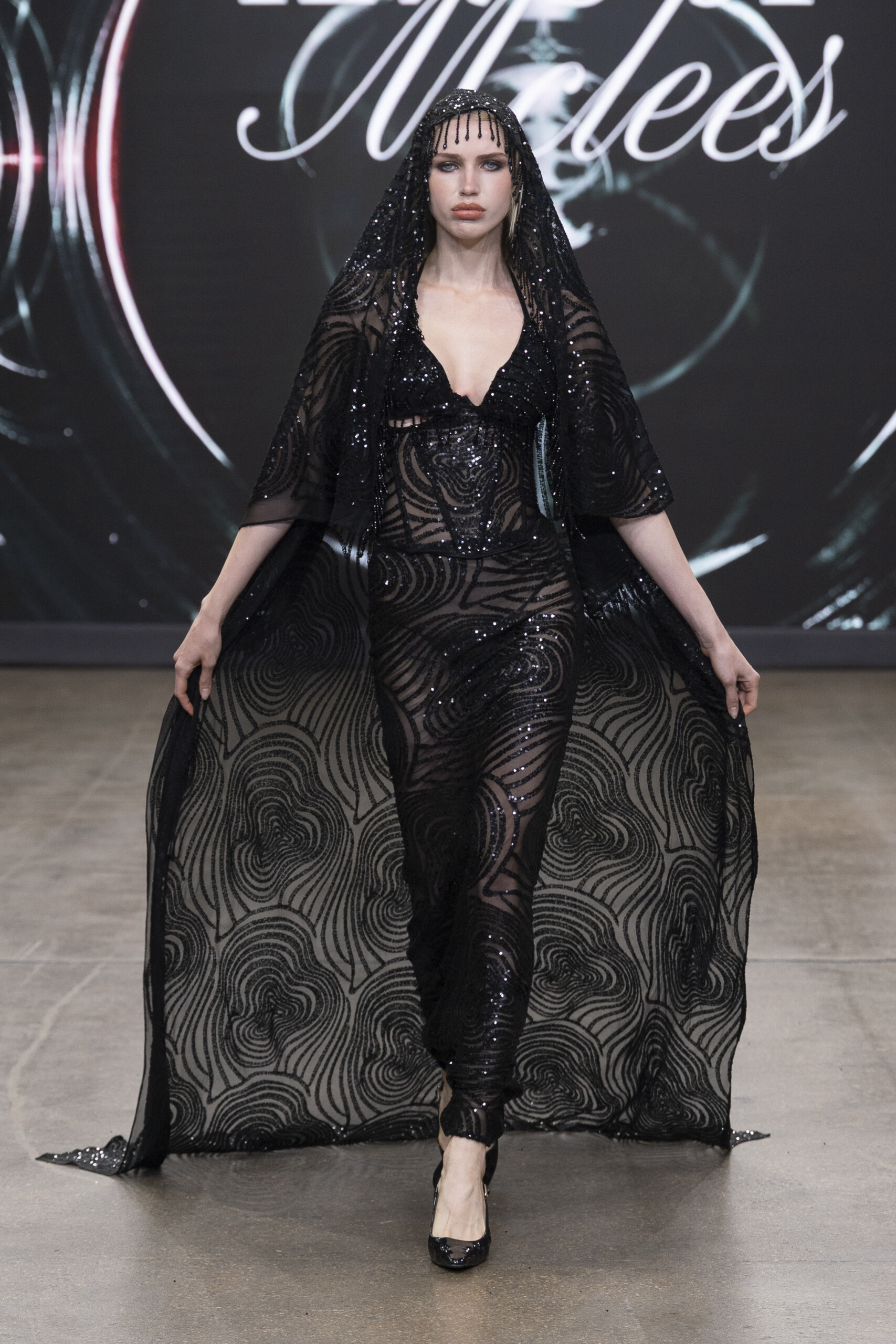
Haus of Mclees presented RENATUS at London Fashion Week on 19 September, translating ideas of surrender, vulnerability and rebirth into intricate hand-beading, exposed silhouettes and sculptural forms. Designed by Swiss and Native American founder Mclees Mantegazza, the collection combines silk, embellished mesh, crystals and semi-precious stones with recycled materials, using a tightly controlled palette of black, white, silver and gold to trace its movement from darkness towards light. The collection appeared on Fashion Scout’s official London Fashion Week schedule on Saturday afternoon at its Shoreditch venue.
Beadwork as Memory and Construction
The title RENATUS, Latin for “reborn”, comes from a project Mantegazza first developed during her master’s degree. The original book examined the experience of losing oneself to darkness before confronting a more vulnerable version of the self, and that premise became the foundation for a collection concerned with surrender, renewal and beginning again.
Yet the collection’s most tangible connection to Mantegazza’s own history is beadwork. Haus of Mclees grew from her engagement with traditional beadwork and time spent with her grandfather on the Wind River Reservation, where she was introduced to the craft. The technique has subsequently become central to the house’s approach to clothing and adornment.
In RENATUS, that practice is pushed across both garments and surfaces. Crystals and semi-precious stones sit alongside embroidery and embellished mesh, while sculptural silhouettes expose rather than obscure parts of the body. The contrast is significant: dense, labour-intensive decoration meets openness and vulnerability, giving the collection a physical expression of its psychological premise.




From Darkness to Continuity
Black, white, silver and gold structure the collection’s visual progression without introducing a broad colour narrative. Instead, attention stays on texture, reflective surfaces and the relationship between body and embellishment.
Angelic and religious imagery appears alongside references to the natural world, while the spiral recurs as a symbol of continuity and return. According to the collection notes, Mantegazza also draws in part on her Native American heritage in approaching death not simply as an ending but within a continual process of transformation.
That concept could easily remain purely symbolic, but RENATUS connects it to the way the garments themselves are produced. Haus of Mclees works in limited quantities, with many pieces made to order at its Notting Hill atelier. The brand says recycled, repurposed and second-hand materials are used wherever possible, while the majority of garments are handcrafted by its small team of designers and artisans.
Selected jewellery by Lady Pill Art, created in collaboration with Taylor Papadakis, extends the emphasis on adornment beyond clothing, reinforcing the collection’s interest in objects placed directly around the body.
An Atelier Built Around Individual Pieces
Haus of Mclees also positions customisation as part of its working model. Inclusive sizing, custom orders and made-to-order production allow individual garments to be developed around different bodies and forms of personal expression. The house describes Indigenous visibility and respectful representation as part of its identity as a Native American-founded label.
The brand’s development is now moving beyond its London base. According to the press release, Haus of Mclees plans to show during Paris Fashion Week in October 2026 before relocating to Miami in January 2027, where expanded collections, new ready-to-wear and a larger menswear line are planned alongside the continuation of bespoke couture and custom commissions.
For RENATUS, however, scale is less important than the relationship between technique and meaning. Hand-beading is not simply decorative excess; exposed silhouettes are not simply a device for sensuality. Both contribute to a collection built around the idea of stripping something back before rebuilding it. Through that tension between vulnerability and elaborate surface work, Haus of Mclees gives the language of rebirth a distinctly physical form.
More from Haus of Mclees.

FASHION FRONTIER
Fashion Frontier is a London-based digital fashion magazine exploring the edge of modern style, creativity, and culture. The platform features designer lookbooks, runway reports, event coverage, and stories redefining the future of fashion in the UK and beyond.
You may also like

Emerging Designer Zhaoyi Yu Debuts ‘GLIMPSE’ SS25 Collection at London Fashion Week
Emerging couture fashion designer Zhaoyi Yu made his highly anticipated debut at London Fashion Week

FALL WINTER 2025: KALIGHAT STORIES – A Fusion of Heritage and Haute Couture
Barrus makes a striking return at London Fashion Week with its Autumn/Winter 2025 collection—a vis

London Fashion Week Shop Opening Recap on Regent Street
The London Fashion Week Shop, presented by 1664 Blanc, was officially opened on Regent Street, marki



Post a comment