


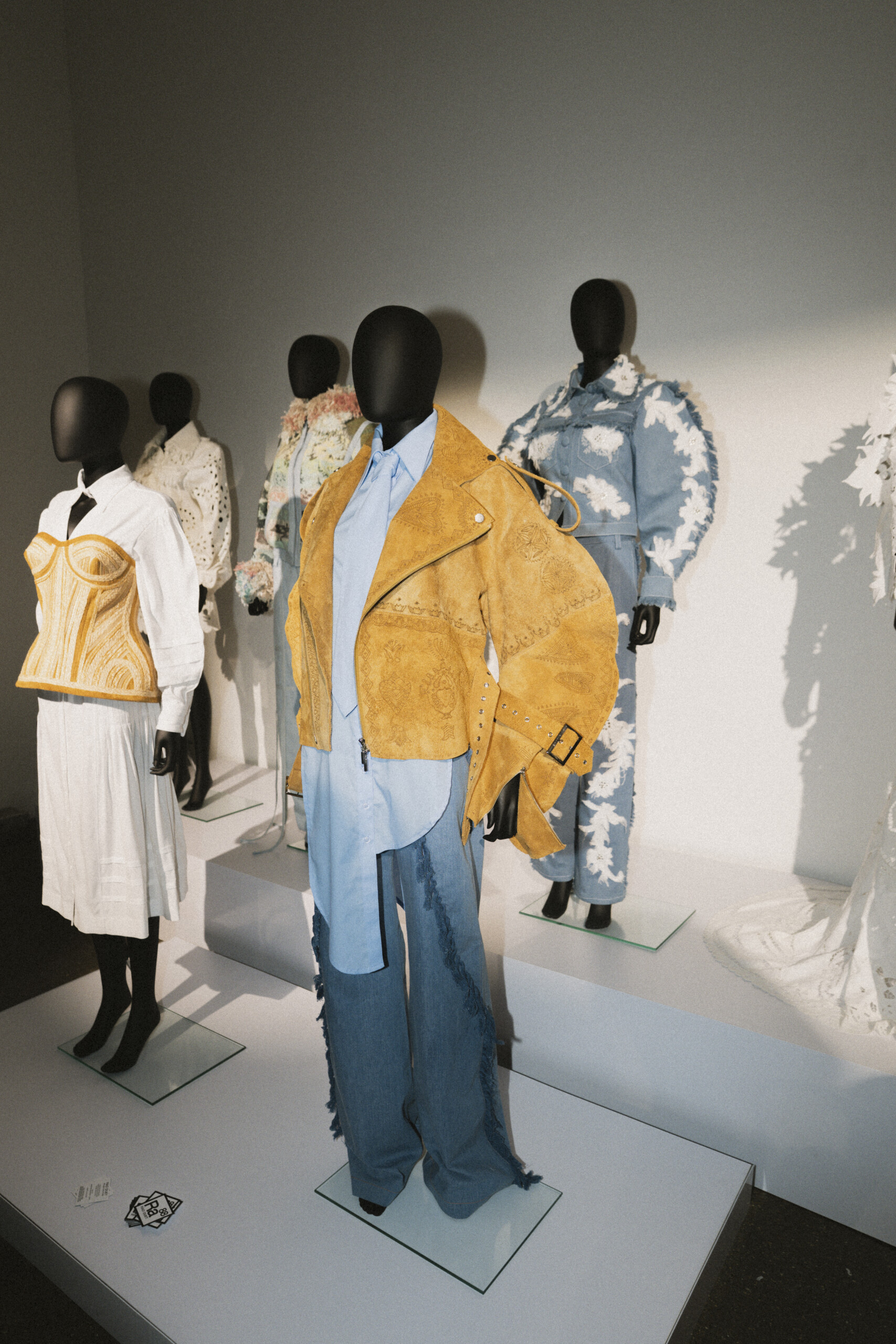
BEYOND LIMITS: Polish Visionaries brought 12 Polish fashion and jewellery designers to London from 19 to 21 September, creating a three-day showcase within Fashion Scout’s London Fashion Week programme at Protein Studios in Shoreditch. Bringing together eight fashion designers and four jewellery practices, the project avoided a single national aesthetic in favour of a broader picture of contemporary Polish design, moving between folklore, corsetry, recycled materials, streetwear, goldsmithing and wearable sculpture.
Presented by the Creative Industries Institute (IPK), the exhibition placed heritage alongside experimentation rather than treating the two as opposites. Across the participating practices, established techniques and cultural references became starting points for questions around identity, craftsmanship, gender and the role of fashion beyond its purely functional purpose.


Eight Fashion Practices, Eight Different Perspectives
Hubert Pelc, a graduate of the Academy of Fine Arts in Warsaw, approaches clothing as a form of artistic expression. His work examines identity and belonging through the interaction between tradition and experimentation, positioning fashion as a medium through which personal and cultural narratives can be negotiated.
Martyna Konieczny, founder of independent label No Przesada and a graduate of the Academy of Fine Arts in Łódź, turns to Polish folklore. Rather than reproducing traditional motifs unchanged, she transforms them into unconventional forms that challenge familiar expectations of how cultural references should appear in contemporary fashion.
Historical narratives also inform Robert Czerwik, whose collections are characterised by meticulous detailing and references to strong women from the past.
RAD DUET takes Polish culture, identity and craftsmanship as recurring subjects. The brand’s work has entered permanent museum collections in Poland, placing its fashion practice in a context that extends beyond seasonal presentation and into cultural preservation.
For Katarzyna Konieczka, the boundary between clothing and object becomes deliberately unstable. Sculptural silhouettes, contemporary corsetry and architectural headpieces move her work towards wearable art, allowing the body to function as a site for experimentation with proportion and construction.
Leather, Masculinity and Recycled Material
Michał Szulc works with leather through a contemporary streetwear vocabulary while incorporating deadstock materials into his design process. This combination of an established luxury material with strategies of material reuse demonstrates one of the recurring tensions within BEYOND LIMITS: familiar fashion codes are retained, but their context is changed.
KARDASJAN addresses sensuality, masculinity and the body through menswear. The practice challenges conventional expectations of masculine dress with a more provocative visual language, using clothing to question rather than reinforce established gender codes.
Meanwhile, Tomasz Armada uses recycled materials as part of a broader exploration of Polish culture and national identity. His work treats material value and cultural value as connected questions, asking what happens when discarded resources are used to construct new narratives around tradition.
Together, these designers show that Polish identity within the exhibition is not represented by one textile, silhouette or historical reference. It emerges through several competing and complementary interpretations.




Jewellery Between Goldsmithing and Sculpture
The exhibition’s four jewellery practices expanded the conversation beyond clothing.
Radek Anais Laró works across fashion, sculpture, contemporary art and performance, combining traditional goldsmithing techniques with an experimental approach to one-of-a-kind jewellery. The result treats adornment less as a finishing detail and more as an independent artistic object.
Rzucidło reinterprets tribal and ethnic jewellery traditions through a contemporary perspective, with music and subculture shaping its visual vocabulary.
Anna Samków works on a more intimate scale, creating personalised miniature objects from precious metals, gemstones and organic materials. Irregular textures, raw surfaces and unexpected forms give the jewellery a deliberately individual character.
Stettin Jewellery, founded by Polish–Australian duo Patrycja Bołzan and Karlo Szczepaniak, connects traditional goldsmithing with experimentation. Their bespoke pieces are handcrafted in the duo’s own studio, maintaining the importance of technical knowledge while allowing established methods to develop into a more personal design language.
Polish Design Without a Single Definition
What gave BEYOND LIMITS coherence was precisely its refusal to define contemporary Polish design through one look. Folklore appeared alongside streetwear; corsetry beside recycled materials; conventional goldsmithing beside jewellery conceived as sculpture.
The exhibition instead presented heritage as something active. Cultural identity could be preserved, questioned, fragmented or rebuilt depending on the designer working with it.
That breadth also made the London setting significant. Rather than presenting Polish fashion simply as a national showcase, BEYOND LIMITS placed individual designers within a wider international conversation about craft, contemporary identity and the increasingly porous boundaries between fashion, jewellery and art.
GQ Poland served as the project’s exclusive media partner, while the three-day presentation formed part of Fashion Scout’s London Fashion Week programme.

FASHION FRONTIER
Fashion Frontier is a London-based digital fashion magazine exploring the edge of modern style, creativity, and culture. The platform features designer lookbooks, runway reports, event coverage, and stories redefining the future of fashion in the UK and beyond.
You may also like

“One of a Kind”: Odessa Fashion Day Season 32 kept Ukrainian fashion visible, individual and moving forward
Some cities refuse to go quiet. In May, Odesa became one of them again as Odessa Fashion Day held it

“Supporting them helps keep creativity alive”: Pardis on the vision behind London Fashion Day’s Season 7 campaign
At sunrise on Regent Street, London Fashion Day produced the campaign for its upcoming Season 7, usi

Alex S. Yu Debuts “Interlude 3688” F/W’25 Collection at London Fashion Week | Global Fashion Collective Showcase
Global Fashion Collective (GFC), in collaboration with the influential platform Fashion Scout, succe




Post a comment